Adaptogens and Sleep: Can Herbs Really Improve Your Rest? Adaptogens & Sleep · Vibrant Life Symphony Adaptogens and Sleep: Can Herbs Really Improve Your Rest? Evidence-Based 13 min read Adaptogens Series If you've read our sleep hygiene checklist or our guide on high cortisol at night, you already know how tightly stress and sleep are intertwined. So it's natural to wonder: if adaptogens genuinely lower cortisol, shouldn't they also fix sleep? The honest answer, based on 2025-2026 research, is more nuanced than the wellness industry usually admits — some adaptogens genuinely help, others don't do much for sleep specifically, and even the best ones have real limits. This guide connects two threads we've covered separately: the cortisol-sleep science from our sleep series, and the adaptogen research from this series — so you can understand exactly where herbs fit int...
Blue Light and Sleep: The Complete Guide to Protecting Your Sleep From Screens
Blue Light and Sleep: The Complete Guide to Protecting Your Sleep From Screens
Sleep Science · Vibrant Life Symphony
Blue Light and Sleep: The Complete Guide to Protecting Your Sleep From Screens
Evidence-Based13 min readUpdated July 2026
You know the routine. Lying in bed, phone in hand, "just checking one more thing" before sleep. Twenty minutes later, you're still scrolling — and somehow more awake than when you picked it up. This isn't a willpower problem. It's biology, and in the last year, the science behind it has gotten remarkably precise.
Nearly 90% of Americans use an electronic device within one hour of bedtime. Understanding exactly what blue light does to your brain — and what genuinely works to counteract it — may be one of the highest-leverage changes you can make to the rest of your sleep hygiene routine.
90%
Of Americans use screens within 1 hour of bedtime
2 hrs
Blue light kept melatonin suppressed vs. red light recovery
12.3%
Melatonin suppression from cool white LED bulbs
3.6%
Melatonin suppression from warm white LED — far gentler
What Blue Light Actually Does to Your Brain
Digital screens — smartphones, tablets, computers — emit light concentrated in the short wavelength range of roughly 400-500 nanometers, commonly called blue light. This wavelength range has an outsized effect on a specific type of cell in your eyes called intrinsically photosensitive retinal ganglion cells, which contain a photopigment called melanopsin.
These cells feed directly into the suprachiasmatic nucleus — your brain's master biological clock, located in the hypothalamus — which regulates the sleep-wake cycle largely through melatonin secretion from the pineal gland. When blue light hits these cells in the evening, it sends your brain a powerful, direct signal: it's still daytime. Melatonin production gets suppressed, and your internal clock delays.
🔬 The 2025 Study That Nailed Down the Timeline
A rigorous 2025 study published in the journal Photonics exposed 12 healthy adults to red and blue LED light for three hours in the evening, tracking melatonin via hourly saliva samples. The findings were striking: after just one hour, both light types suppressed melatonin similarly. But by two hours, a clear divergence emerged — blue light kept melatonin suppressed at just 7.5 pg/mL, while red light allowed levels to recover to 26.0 pg/mL, a statistically significant difference.
Key insight: This means duration matters as much as light color. A quick glance at your phone may not derail your sleep — but extended scrolling sessions in blue-enriched light compound the suppression effect the longer they continue.
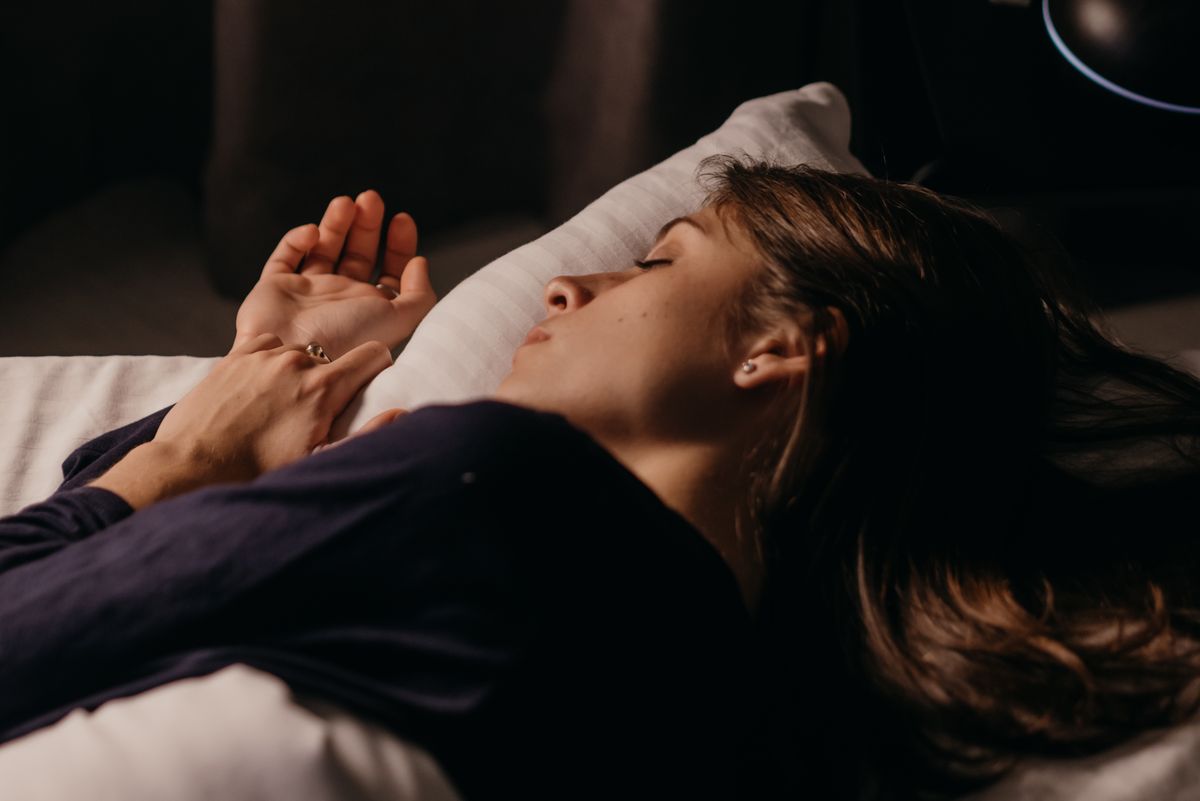
Protecting your evening hours from blue light exposure allows melatonin to rise naturally, supporting faster sleep onset and deeper rest.
The Two Ways Blue Light Sabotages Sleep
Melatonin Suppression
Blue light directly suppresses the hormone responsible for signaling to your body that it's time to sleep, delaying sleep onset and reducing overall sleep quality.
Technostress & Arousal
Beyond the light itself, the constant novelty of digital interfaces creates physiological hyperarousal — including elevated cortisol — that keeps the nervous system alert well past bedtime.
This second mechanism is often overlooked: it's not just the wavelength of light — it's the psychological stimulation of notifications, social media, and endless content that keeps your brain in an active, vigilant state precisely when it should be winding down.
This is one of the most searched questions on the topic, and 2025 gave us a much clearer answer. A systematic review and meta-analysis of double-blind, randomized controlled crossover trials, registered in PROSPERO and published in Frontiers in Neurology, evaluated blue-light blocking glasses (BBGs) against clear lenses for objective sleep outcomes measured by actigraphy — sleep onset latency, total sleep time, sleep efficiency, and wake after sleep onset.
The finding: BBGs showed measurable improvements in objective sleep outcomes compared to clear lenses. However, the researchers were careful to note that the evidence base remains built on a small number of trials, and larger studies are still needed to confirm the full size of the effect.
A separate 2025 study in Japanese schoolchildren found that partial blue-light blocking glasses worn at night advanced sleep phase timing and improved daytime mood and behavior — even though it did not significantly change salivary melatonin levels, suggesting blue light's impact on sleep may work through multiple pathways beyond melatonin alone.
Warm-toned lighting in the evening produces dramatically less melatonin suppression than cool white light sources.
Not All Light Bulbs Are Equal
A 2026 study published in Scientific Reports characterized light emissions from 52 different lamps across LED, incandescent, and CFL technologies, calculating a Melatonin Suppression Value (MSV) for each.
Melatonin Suppression by Bulb Type
Cool White LED
12.3%
Cool White CFL
12.1%
Warm White LED
3.6%
Warm White CFL
2.6%
Incandescent
1.5%
Lower Melatonin Suppression Value (MSV) means less disruption to your natural sleep hormone.
Practical takeaway: Simply swapping "cool white" or "daylight" bulbs for "warm white" or "soft white" bulbs in your bedroom and living room lamps used in the evening is one of the easiest, lowest-effort changes with real measured impact.
🛏️
Build a Complete Screen-Free Wind-Down
Reducing blue light exposure works best as part of a full evening routine — one where your body also feels physically ready to let go of the day. The Derila Ergo's ergonomic butterfly design supports that transition by keeping your neck and spine properly aligned the moment you set the screens aside, removing a physical source of restlessness from your wind-down routine.
Most sleep researchers recommend avoiding screens for 60-90 minutes before bed to allow melatonin release to begin naturally and uninterrupted.
2
Use Night Mode and Lower Brightness
If eliminating screens entirely isn't realistic, activate your device's built-in night mode or blue light filter in the evening, and manually reduce screen brightness to the lowest comfortable level.
3
Consider Blue Light Blocking Glasses
For situations where screen use before bed is unavoidable — shift workers, late-night studying, or simply modern life — blue-light blocking glasses have shown measurable improvement in objective sleep outcomes in controlled trials.
4
Switch to Warm-Toned Bulbs in the Evening
Replace cool white or daylight bulbs with warm white or soft white bulbs in bedroom and living room lamps used after sunset — a simple swap with a measured 3-4x reduction in melatonin suppression compared to cool white lighting.
5
Get Bright Light Exposure Earlier in the Day
Since your circadian system is most sensitive to light timing, prioritizing bright light — ideally natural sunlight — in the morning and midday helps reinforce a healthy rhythm, making evening light exposure comparatively less disruptive.
6
Address the Psychological Stimulation, Not Just the Light
Replace scrolling with genuinely calming, low-stimulation activities — reading a physical book, journaling, gentle stretching — to counteract the technostress-driven arousal that keeps the nervous system alert independent of light wavelength.
Remember: Start with the two or three changes that are easiest for your lifestyle — often the warm bulb swap and a shorter screen buffer are the simplest first wins — then build from there.
When to See a Doctor
If you've consistently applied blue light reduction strategies for several weeks alongside general sleep hygiene practices and still struggle significantly with sleep onset, staying asleep, or persistent daytime fatigue, consult a healthcare provider or sleep specialist to rule out underlying sleep disorders that require additional treatment.
✦
Small Changes, Measurable Results
The science on blue light and sleep has matured significantly — we now have double-blind trials, precise melatonin suppression values for common light sources, and meta-analyses on blocking glasses. What emerges is reassuring: you don't need to abandon technology entirely. Targeted, evidence-based changes — a screen buffer, warmer bulbs, night mode, and addressing the psychological pull of your devices — can meaningfully protect your sleep in a world that's unlikely to get less digital anytime soon.
🌙
Complete Your Screen-Free Sleep Routine
Once the lights are dimmed and the screens are away, physical comfort becomes the final piece of a truly restorative wind-down. The Derila Ergo's revolutionary ergonomic design keeps your neck and spine perfectly aligned all night, supporting the deep, uninterrupted sleep your blue-light-free evening routine is working to protect.
Currently 75% off · Doctor-recommended · Risk-free trial
Yes. Multiple 2025-2026 studies confirm blue light suppresses melatonin more strongly and for longer than other wavelengths. One controlled study found blue light kept melatonin suppressed at 7.5 pg/mL after two hours, while red light allowed recovery to 26.0 pg/mL in the same timeframe.
Do blue light blocking glasses actually work?
A 2025 systematic review and meta-analysis of double-blind crossover randomized controlled trials found blue-light blocking glasses improved objective sleep outcomes including sleep onset latency and sleep efficiency, though researchers note more large-scale trials are needed to confirm the size of the effect.
How many Americans use screens before bed?
Research indicates approximately 90% of Americans use an electronic device within one hour of bedtime, making blue light exposure one of the most widespread and modifiable sleep disruptors in modern life.
What light bulbs are best for sleep?
Research measuring melatonin suppression values found warm white LED and warm white CFL bulbs suppress melatonin far less (around 3.6% and 2.6% respectively) than cool white LED or cool white CFL bulbs (around 12.3% and 12.1%), making warm-toned lighting the better choice for evening hours.
How long before bed should I avoid screens?
Most sleep researchers recommend avoiding screens for 60-90 minutes before bed to allow melatonin release to begin naturally. If eliminating screens isn't realistic, using night mode, dimming brightness, and blue light blocking glasses can meaningfully reduce the disruption.
Sources & References
Sanchez-Cano A, et al. — "Comparative Effects of Red and Blue LED Light on Melatonin Levels" — Photonics 2025;15(5):715 — mdpi.com
Luna-Rangel FA, et al. — "Efficacy of blue-light blocking glasses on actigraphic sleep outcomes: a systematic review and meta-analysis" — Front Neurol. 2025 — frontiersin.org
Home lighting, blue-light filtering, and melatonin suppression — Scientific Reports 2026;16:2850 — nature.com
Maeda-Nishino NJ, et al. — "Partial blue light blocking glasses at night advanced sleep phase" — PLOS One 2025 — journals.plos.org
Rowan-Virtua Research — "Effects of Blue Light from Technology on Sleep Health" (2026) — rdw.rowan.edu
Gooley JJ, et al. — "Exposure to room light before bedtime suppresses melatonin onset" — J Clin Endocrinol Metab. 2011;96(3):E463-E472


Comments
Post a Comment